Heraldry

Heraldry is about science and the art of describing coats of arms.Know here the description of the coat of arms of the city of Fatima, the respective flag and the logo.
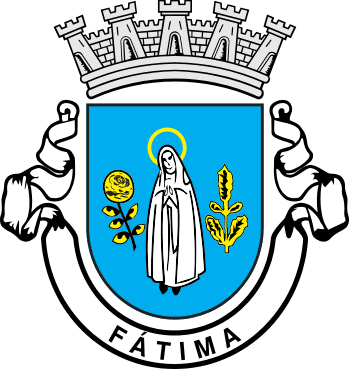
COAT OF ARMS
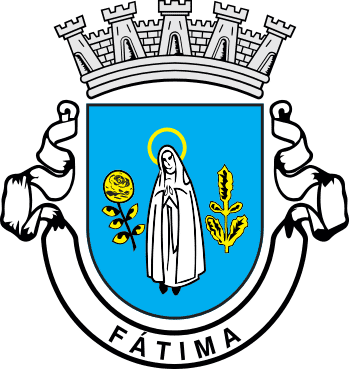 Blue shield, in the center an image of Our Lady of Fatima with a golden halo, flanked by a golden rose (rosa áurea) at dexter and a golden oak twig (three leaves, two acorns) at sinister. Silver Mural crown with five visible towers and white scroll reading in black upper case letters "FÁTIMA".
FLAG: with the coat of arms centered on a quartered field of blue and yellow. Cord and tassels of gold and blue. Stem and spear in gold.
EMBOSSING SEAL : In accordance with the law, with the caption "Junta de Freguesia de Fátima: Ourém" (Fatima Parish Council: Ourem).
IMAGE: Our Lady appeared, was seen by three children and the image was designed according to their description of Her. There couldn’t have been any stronger symbol to represent the Parish of Fatima, on its coat of arms and on its flag. Therefore the image appears in the center of the shield, slightly lowered to represent the "descent" of Our Lady to Earth, with the image occupying the most outstanding part of the shield. The image is white (correct term in Heraldry: Silver), the same natural and predominant color of the statue that is in the Sanctuary. The space above the image was left blank to indicate that She came from "above", that is, from Heaven. The image of Our Lady of Fatima is usually represented with the golden royal crown and with the three little children kneeling.
In Heraldic rigor, the only image that has the right to wear the crown is Our Lady of Vila Viçosa to whom King John IV offered his crown. There is no evidence of the shepherds having seen "a crowned Lady".
HOLM OAK TWIG: This symbolises three things, the first, the holm oak on which Our Lady came to rest, the second, the Patron Saint of the Parish, Saint Anthony, who in Heraldry is represented by one of his attributes: a cross with twelve acorns, and the third, along with the heraldic rose, it symbolizes the agriculture and the rurality of the Parish.
SHIELD BACKGROUND: It is blue, also the color representing Our Lady in Heraldry.
MURAL CROWN: Mural crown Argent with five visible towers representing the rank of City.
LISTEL: White listel. The white crown and the white image require a white listel. On it is written the word "FÁTIMA", a subtle allusion to the person after whom the place was named: Fatema or Fatma, the noble Moor who was captured by the Templar Knight, Gonçalo Hermingues, whom she married after converting to Catholicism. She subsequently assumed the name of Oriana or Ouriana and this name change gave rise to the name of Ourem, name of the Municipality to which the parish of Fatima belongs). By her conversion and marriage, this lady became Portuguese by right.
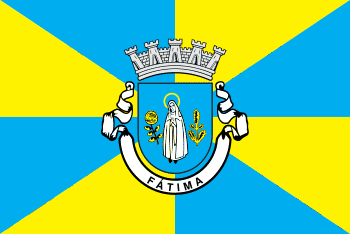
Flag
It is divided into eight squares.
According to the rules, the cord (around the flag/standard) and the tassels are gold and blue. By law, the staff and spear are gold.
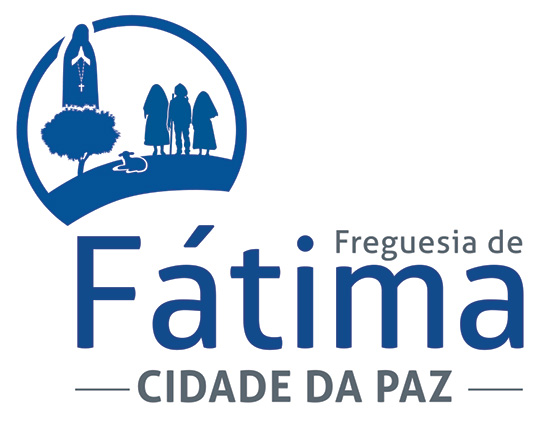
Logotype
Logo Elements:
Miracle (Sun)
The rounded shape refers to the Miracle of the Sun. It was the last apparition of Our Lady, which at that time already brought thousands of people to the site of Fátima.
Location (“Hill”)
This element represents both the city and the parish, highlighting its geography and positioning. Fátima is situated atop a hill and preserves both rural and urban characteristics, making it a special place.
Symbolism (Holm Oak and Our Lady of Fátima)
The holm oak stands out for its symbolism, representing the apparition of Our Lady to the three shepherd children. Moreover, the holm oak is also a symbol of the parish, as there is hardly a street without one.
Seers of Fátima (Shepherd Children)
They are the protagonists of the Apparitions. Three children from the parish of Fátima had the privilege of seeing Our Lady.
Color
Blue, besides being similar to the color of the Parish of Fátima’s coat of arms, is also one of the colors commonly associated with the image of the Virgin Mary, conveying serenity.
Element Arrangement
The position of the shepherd children atop the “hill” indicates that they are in Fátima and that the city is elevated. The holm oak is placed to be the center of attention for the shepherd children. The rounded shape surrounding the “hill,” the shepherd children, and Our Lady in the holm oak represents the miracle witnessed in Fátima.